Moving is a process of discovery-- I've been finding old notes, photographs, yearbooks, dried flowers, buttons, nails, pens and folders of overly-detailed class notes from four years of undergraduate education.
I've also found a lot of CLP notes, from India to California. Some from plane rides in between the two. Some cryptic, some anthropological, some poetic.
Some without titles. Like this one, scribbled across three sheets, ripped out and attached to a list of "Social Service Activities" compiled by the Lights of India in Tiruchirapalli, Tamil Nadu in August 2008...
-----------------------
Untitled, Undated Field Notes (India, August 2008)
Why do we do it? Where? How? Purpose.
Marriage moment: Why don't you work locally? Why do we have to choose?
What are you doing with your life?
I'm unifying mind and action.
[Thinking Florida.]
--> Fantasy world.
--> Letter from God.
--> As I looked beneath me, I was making the road.
The weight of that moment-- to do international organizing the right way requires it to consume you. I want to let it consume me. Studying in endless hunger. Read till it becomes you. Stay up late... creating, becoming, developing.
Service, activism, social justice is a full-time job. There is nothing compartmental about it.
Flexibility. Fearlessness.
These are real lives. Where is US where is THEM ?
[A new definition]: Self-activism: a radical confrontation.
(Real social justice is transformation.)
You should get somewhere and feel fearlessly stupid.
--> Humility.
--> FEARLESS HUMILITY.
"You are a CRAZY American girl!"
--> Identity.
--> Foreigner.
--> Female.
--> Unmarried.
[[Enigma]].
Sunday, June 21, 2009

Monday, March 23, 2009
Higher education in India... let the market provide?
An interesting article from the Economist:
(http://www.economist.com/specialreports/displaystory.cfm?story_id=12749787)
Special Report on India: Creaking, groaning- Dec 11th 2008
"Primary education is a particular worry. It is hard to teach illiterate Indian women basic hygiene. Illiterate men are not equipped for productive employment. Yet in 2001 only 65% of the population was literate, optimistically defined, compared with 90% in China, even though every Indian government for the past two decades has vowed to fix primary education. The current government is no exception. It has increased the overall education budget, but not much. Last year it represented 2.8% of GDP, about half the figure in Kenya.
(http://www.economist.com/specialreports/displaystory.cfm?story_id=12749787)
Special Report on India: Creaking, groaning- Dec 11th 2008
"Primary education is a particular worry. It is hard to teach illiterate Indian women basic hygiene. Illiterate men are not equipped for productive employment. Yet in 2001 only 65% of the population was literate, optimistically defined, compared with 90% in China, even though every Indian government for the past two decades has vowed to fix primary education. The current government is no exception. It has increased the overall education budget, but not much. Last year it represented 2.8% of GDP, about half the figure in Kenya. At least almost all Indian children now go to school: a survey of 16,000 villages carried out last year by ASER, an NGO, put the enrolment rate at 96%. But it also pointed to the appalling quality of education on offer. Half of ten-year-olds could not read to the basic standard expected of six-year-olds. Over 60% could not do simple division. One reason is that, according to a World Bank study, only half of Indian teachers show up to work. Half of Indian children leave school by the age of 14.
Let the market provide?Or rather, many of them turn to private schools, on which poor Indians spend 2% of their incomes. Many of these are wholly unregulated, but apparently no worse for it. A study of a Hyderabad slum, by James Tooley of Britain’s Newcastle University, found that of 918 schools, 35% were government-run, 23% were private but officially approved, and 37% were informal. The private schools were better. In a standardised test the informal private schools actually came out best, with an average mark of 59.5% in English, compared with 22.4% in the government schools.
Clearly the government should support the grey market in education that its own failings have given rise to. It should make it easier for private schools to get approval. Their teaching materials could then be upgraded and standardised. ASER’s survey also suggests that, with a few sensible steps, big improvements are possible even in state-run schools. By making teachers accountable to local governments, Bihar, India’s most unlettered state, roughly halved its truancy rate last year. A draft law awaiting parliamentary approval would make similar changes across India.
Higher education is another candidate for reform. In the past five years the rate of enrolment in higher education has taken off, from 7% to 13% of young Indians. But the quality of teaching at India’s 348 universities and some 18,000 colleges is generally poor. NASSCOM, the IT industry’s lobby group, reckons that of the 350,000 engineering graduates who emerge each year, mostly from private colleges, 25% are unemployable without extensive further training, and half are just unemployable.
In response to an urgent need, the central government has announced plans for 30 new centrally run institutions. These will not be first-rate. In a recent ranking of the world’s 500 best universities by Shanghai Jiao Tong University, only two were from India. But the new central institutions will be much better than most Indian public universities, which are run by state governments. In these places the teaching is mostly dreadful, syllabuses are outdated and facilities can be a health hazard.
Many private establishments (which must be affiliated to a public university and cannot be run for profit) suffer the same deficiencies. With demand for higher education outstripping supply, they have little incentive to improve. Cumbersome and politicised regulators add to their woes. Getting approval to open a nursing college in India can take years even though there is a dire shortage of nurses, with only 30% of nursing jobs in rural hospitals filled. Almost the only investors who would submit themselves to this process are the politicians who control it, and indeed many of them own universities.
In a recent paper on India’s higher education, Pratap Bhanu Mehta and Devesh Kapur call it “the collateral damage of Indian politics”. For corrupt state-level rulers, a tightly regulated university system has many benefits. Politicians, or their lackeys, collect bribes for appointing faculty, admitting students and awarding good grades. They insert their supporters to run the racket. Having destroyed a public university, they then grant themselves permission to open a private one from which, illegally, they milk profits. India’s politicians would clearly be mad to reform this system."
Friday, January 23, 2009
CLP: Its time to "Barack" and Roll
"To the people of poor nations, we pledge to work alongside you to make your farms flourish and let clean waters flow; to nourish starved bodies and feed hungry minds. And to those nations like ours that enjoy relative plenty, we say we can no longer afford indifference to the suffering outside our borders; nor can we consume the world's resources without regard to effect. For the world has changed, and we must change with it."
- Inauguration speech, President Barack H. Obama
On Inauguration Day morning, I sat with my family over a glass of champagne to celebrate Barack Obama's first day as the 44th President of the United States. For most of my political life I've known only the experience of George W. Bush-- I've known of resolutions and legislation with which I disagreed on issues of importance for education, women, environment, and international peace. I've seen war. I've seen Guantanamo. I've seen tax cuts that, when paired with ignorance and arrogance by a government intended to set some limits on greed, have resulted in a hallowing recession-- if not depression-- at the same time I plan to graduate with a BA in Global Studies and Religion. The Assistant Director of CLP is preparing to move to a cheaper place as her department store employer makes hints at bankruptcy. Students at UCR may have to take unexpected time off as their parents can no longer afford to send them. Grants? Who knows what will happen with those.
What is it like to grow up in a depression? In relationship to my fellow American citizens, I enjoy relative plenty-- two parents with secure jobs, and no debt in my name. Miraculously, I started a new, well-paying job this quarter as an English Tutor, and although my family has made the decision to "tighten down the house" in fear of a possible lay-off of teachers and education staff, I keep an image of the "New Deal" in my head-- heck, if anything goes really bad, I'll start doing manual labor on a development project-- but not in India, in the USA.
But what about India? What do times like these mean for our responsibilities and relationships abroad?
India has its own set of stimulus packages. An individual within our partner organization, ASA-GV, a microfinance institute, has noted a general sense of concern for the stability and sustainability of their organization as well.
Even in the face of our economic crisis, a crisis that is transnational and interconnected to the economies across the world, I feel our obligation and our responsbilities remain. I have still seen the generosities and willingness of people to be "risky" on "development investments." What better savings, what better investment, than the education of youth and young adults in India and Southern California? These our are youth, our children, and we strive to fulfill our responsbilities to them, to uphold the worth of their future, even in the face of our self-created crisises.
When Obama mentioned "non-believers" in his list of the religious constitutencies of the USA, my brother-in-law smiled and giddily exclaimed to the family-- "Yes! Thats my president!" Finally, a president that validated and spoke to the feelings and beliefs of their constituency-- even a constitutency they may not agree with or relate to.
For me, Obama was "my president" when he described working "alongside" people from across the globe to "feed hungry minds." What better way to describe what CLP strives to do? Work alongside people all over the world to feed hungry minds-- including our own.
With a new sense of connection to our own leadership, our work certainly continues.
Gates on the future of aid:
http://audiovideo.economist.com/?fr_story=11ebb33e58a9ff8214910041ef6052e744cfdece&rf=bm
India's Primary Education:
http://audiovideo.economist.com/?fr_story=245b1271041e7d13684d8e8f331abac64f28cf3b&rf=bm
- Inauguration speech, President Barack H. Obama
On Inauguration Day morning, I sat with my family over a glass of champagne to celebrate Barack Obama's first day as the 44th President of the United States. For most of my political life I've known only the experience of George W. Bush-- I've known of resolutions and legislation with which I disagreed on issues of importance for education, women, environment, and international peace. I've seen war. I've seen Guantanamo. I've seen tax cuts that, when paired with ignorance and arrogance by a government intended to set some limits on greed, have resulted in a hallowing recession-- if not depression-- at the same time I plan to graduate with a BA in Global Studies and Religion. The Assistant Director of CLP is preparing to move to a cheaper place as her department store employer makes hints at bankruptcy. Students at UCR may have to take unexpected time off as their parents can no longer afford to send them. Grants? Who knows what will happen with those.
What is it like to grow up in a depression? In relationship to my fellow American citizens, I enjoy relative plenty-- two parents with secure jobs, and no debt in my name. Miraculously, I started a new, well-paying job this quarter as an English Tutor, and although my family has made the decision to "tighten down the house" in fear of a possible lay-off of teachers and education staff, I keep an image of the "New Deal" in my head-- heck, if anything goes really bad, I'll start doing manual labor on a development project-- but not in India, in the USA.
But what about India? What do times like these mean for our responsibilities and relationships abroad?
India has its own set of stimulus packages. An individual within our partner organization, ASA-GV, a microfinance institute, has noted a general sense of concern for the stability and sustainability of their organization as well.
Even in the face of our economic crisis, a crisis that is transnational and interconnected to the economies across the world, I feel our obligation and our responsbilities remain. I have still seen the generosities and willingness of people to be "risky" on "development investments." What better savings, what better investment, than the education of youth and young adults in India and Southern California? These our are youth, our children, and we strive to fulfill our responsbilities to them, to uphold the worth of their future, even in the face of our self-created crisises.
When Obama mentioned "non-believers" in his list of the religious constitutencies of the USA, my brother-in-law smiled and giddily exclaimed to the family-- "Yes! Thats my president!" Finally, a president that validated and spoke to the feelings and beliefs of their constituency-- even a constitutency they may not agree with or relate to.
For me, Obama was "my president" when he described working "alongside" people from across the globe to "feed hungry minds." What better way to describe what CLP strives to do? Work alongside people all over the world to feed hungry minds-- including our own.
With a new sense of connection to our own leadership, our work certainly continues.
Gates on the future of aid:
http://audiovideo.economist.com/?fr_story=11ebb33e58a9ff8214910041ef6052e744cfdece&rf=bm
India's Primary Education:
http://audiovideo.economist.com/?fr_story=245b1271041e7d13684d8e8f331abac64f28cf3b&rf=bm
Friday, January 2, 2009
Happy New Year!
Happy New Year from India!
As I write to you from my balcony in Pondicherry, Tamil Nadu on the almost idyllic tropical morning of January 1st, 2009, I hope this email finds you safe and celebratory on the eve of the New Year in California!
After over 30 hours of travel including a six-hour lay over in Dubai (which also included a series of encounters with intoxicated Japanese businessmen, a Starbucks with drinks in Arabic, and an Irish Pub), “Team CLP Phase III” safely arrived in Tamil Nadu, India last Sunday. Since that time, Shady Grove Oliver, Shirley Del Aguila and I have also effectively spent too much personal income at the sunny beach enclave of Mamallapuram on our way to begin work and planning in Pondicherry, where I write to you today. Since our arrival, we have been accompanied by our mother-daughter duo/NGO-partners, Amala and Vasanthi (“Ma”) as well as Ma’s close friends Krishna (“Uncle”) and his friend, Keke.
We’ve had quite a week since our departure from California last Friday.
On Tuesday, December 30th, we embarked on a two-hour bus ride from Mamallapuram to Kanchipuram for a collaborative and exciting meeting with the Rural Institute for Development Education (RIDE) (www.rideindia.org)—a non-governmental organization (NGO) that works specifically to take children out of labor in the silk and stone industries and into one of their twelve “transition schools” before facilitating their entry into the government system. Considering 80% of this area depends on this industry for a living, their 25-year effort in partnership with state and federal government, NGOs, and interested local and international individuals, has been pivotal to decreasing child labor in the wider Kanchipuram area. According to their research surveys, almost 40,000 children were in child labor in the silk mill industry in 1996—a number, they have argued, that has decreased to less than 1,000 thanks to the collaborative work of the organizations listed above (i.e. government labor department providing free machine looms rather than hand looms, enforced laws on advanced payments curbing the willingness of parents to allow children to work, and active outreach on the part of a network of NGOs).
Our future collaboration with RIDE is incredibly exciting—over a two hour meeting, we discussed their work in education and women’s empowerment as related to labor, as well as our work and our ideals with higher education, social justice, and international dialogue in CLP. Upon a viewing of our newly created 10-minute film about our first leadership camp (thanks to the invaluable work of Eamon Conklin), Mr. Jeyaraj was almost moved to tears (having been selected to attend a similar program when he was in the 10th standard that he said “changed the course of his education”), and his wife and him eagerly proposed that we do something similar with graduates from their Child Labor Bridge Schools.
Upon a tour of their “Training Facilities” set in the more remote, rural area of Kanchipuram and surrounded by community gardens to feed the women and children that attend their meetings, we have agree upon a series of “Leadership Programmes” in the Kanchipuram area for Summer 2009 to serve the 15-20 students now aged 14 to 17-years-old who are graduates of their Bridge Schools and have successfully completed 10 years of government education. Futhermore, Mr. Jeyaraj is eager and excited to send information about our organization to other NGOs in his area, with his hope that our program for international dialogue, creativity, social service, peace, and higher education for underserved communities will expand across the South Indian states of “Tamil Nadu, Andhra Pradesh, and Kerala” and someday “all over India, and all over the world!”
After a three hour bus ride from their facilities to our “home base” in Pondicherry, we have spent December 31 in net cafes, coffee shops, and Amala’s Beauty Parlour working on our Leadership Mela for our “Lights of India” who will be spending time in Pondicherry studying higher education, culture, and leadership from Jan. 5 to Jan.8 of next week.
While Shady and Shirley ran around preparing materials for next week’s curriculum and washing our already desperately dirty clothing, Amala and I spent most of our day on her motorbike going from university to university to seek support from principals for tours and lectures about higher education at their facility. We received a warm welcome from the principal of the government-run Tagore’s Arts College—a series of buildings and winding dirt paths that instantly reminded me of my time at the University of Hyderabad in 2007. Although their students will be on holiday, the principal, Dr. Abraham, connected us to two lecturers and administrators from the nearby Polytechnic Universities to provide lectures of higher education and admission to their schools. We will be meeting with them tomorrow, Friday, to firm these plans.
We are also thankful to a myriad of other people who have come out of the community to help us in our task: this includes a friend of Keke’s who does IAS (Indian Administrative Service) coaching for aspiring IAS officers—a number of which are in our Leadership Class! As well as Amala, who will prepare a short presentation on the history of French and British colonization of Pondicherry, so that we may host a analytical discussion on culture and identity to draw parallels to the experiences of our students in Southern California through Shirley’s curriculum, and the 40 packets made by students at Patriot High School in Jurupa Unified School District (thanks again to Toby Walker for his assistance with that component).
Upon leaving the Arts College, Amala and I travelled to Jipmer Medical University, which includes a fully-functioning hospital to meet the needs of the surrounding community. Her uncle works there as a medical social worker, and we were seeking his support to speak to our students (many of which who are aspiring doctors and nurses) about his social work experience at the medical school and in the medical field.
His office, quite appropriately, sits in the middle of the emergency room ward. Outside the building, people were seated and laid all over the street and sidewalk—some surrounded in families, others alone—but almost all moaning or crying out in pain. As we walked into the ward, human bodies laid in all corners of the large, high-ceilinged room, and injections and small operations were taking place right in the public hall way.
I had not been in an Indian hospital since my contracting “malaria” in November 2007, and the smell of the hospital and wounded bodies sent me into a spin, as everywhere I looked people were lying in pain—all, seemingly, on the near edge of death.We decided to sit outside and wait for her uncle to speak to us. Just as we sat on the steps to ward, a small van pulled up with two women inside—one laying across the back seat, the other standing over her crying.
Amala pointed her out to me—“Look, she has been burned” she said.
“What?” I looked over. Her whole body, naked, was scorched, and she wasn’t moving.
“She was cooking and her dress caught fire.”
“Amala—we both know that she doesn’t get caught on fire by cooking.”
Amala responded quietly, “Yeah... I know.”
Domestic abuse between women and men or women and other families often consists of these cases—men (or their families) throwing acid on their wife, or, as the wife cooks or is in the kitchen, men will throw gasoline on their wives and set them on fire—resulting in a purported “cooking” accident.
Hospital workers rushed down from our doorway with a “Burn Victims Unit” stretcher and pulled the woman from the van, rushing her past us as a crying woman followed, reaching out for the victim’s charred hand.
The security guard caught my shock, and, pointing to me, said, “She will die in a few days.”
Amala followed up, “Yes—even with treatment, she will not survive.” Still horrified, I looked to the security guard.
“How often do you see these cases come through?”
“Maybe… 8…9…10 a day.”
The two men driving the van watched the stretcher pass through the doors of the hospital, then, returning to their car, drove away.
I don’t know who the men were. I don’t know who the women were—if they were wealthy, educated, or poor. I don’t know if she had children or what will happen to them now. But I know that the scene was all too familiar to everyone around me, that the woman’s experience was quickly termed a “cooking incident” even though everyone knew what really happened.
Was that the possible fate of the girls in our program? Can this program provide our girls an opportunity to overcome it? Even more importantly, will our program lead to men with different perceptions of women? What are the unseen results and implications of our program in this sector of society? Will our students feel moved to challenge this problem— like the women and men in California who feel called upon to challenge domestic violence or inequality?
As Amala and I drove out of the hospital, still surrounded in bodies upon bodies of people seeking treatment, and continued our tasks for the Leadership Program, I was reminded of something Mr. Jeyaraj told me, smiling, as we left his office just the day before: “Samantha, Child Leader Project is really Child Activist Project—one question you should think about this week is the great implications of making children feel capable of being activists.”
Mindful of this question, I feel that these are the moments that show us, full force, the implications of our work, the importance of the work, and the worth of the work.
So, from these activists in India to you activists back home—thank you again for your support and help with this project. We hope to “see” you January 5, at the UU Church of Riverside, where the Social Justice Committee and CLP will be hosting an international teleconference with our students from here in Pondicherry. Contact Theresa Gilbertson at theresa@childleaderproject.org for more information on how to get involved.
And, now, let us all work for a more just New Year.
In love and action,
Samantha Wilson
Child Leader Project
www.childleaderproject.org
As I write to you from my balcony in Pondicherry, Tamil Nadu on the almost idyllic tropical morning of January 1st, 2009, I hope this email finds you safe and celebratory on the eve of the New Year in California!
After over 30 hours of travel including a six-hour lay over in Dubai (which also included a series of encounters with intoxicated Japanese businessmen, a Starbucks with drinks in Arabic, and an Irish Pub), “Team CLP Phase III” safely arrived in Tamil Nadu, India last Sunday. Since that time, Shady Grove Oliver, Shirley Del Aguila and I have also effectively spent too much personal income at the sunny beach enclave of Mamallapuram on our way to begin work and planning in Pondicherry, where I write to you today. Since our arrival, we have been accompanied by our mother-daughter duo/NGO-partners, Amala and Vasanthi (“Ma”) as well as Ma’s close friends Krishna (“Uncle”) and his friend, Keke.
We’ve had quite a week since our departure from California last Friday.
On Tuesday, December 30th, we embarked on a two-hour bus ride from Mamallapuram to Kanchipuram for a collaborative and exciting meeting with the Rural Institute for Development Education (RIDE) (www.rideindia.org)—a non-governmental organization (NGO) that works specifically to take children out of labor in the silk and stone industries and into one of their twelve “transition schools” before facilitating their entry into the government system. Considering 80% of this area depends on this industry for a living, their 25-year effort in partnership with state and federal government, NGOs, and interested local and international individuals, has been pivotal to decreasing child labor in the wider Kanchipuram area. According to their research surveys, almost 40,000 children were in child labor in the silk mill industry in 1996—a number, they have argued, that has decreased to less than 1,000 thanks to the collaborative work of the organizations listed above (i.e. government labor department providing free machine looms rather than hand looms, enforced laws on advanced payments curbing the willingness of parents to allow children to work, and active outreach on the part of a network of NGOs).
Our future collaboration with RIDE is incredibly exciting—over a two hour meeting, we discussed their work in education and women’s empowerment as related to labor, as well as our work and our ideals with higher education, social justice, and international dialogue in CLP. Upon a viewing of our newly created 10-minute film about our first leadership camp (thanks to the invaluable work of Eamon Conklin), Mr. Jeyaraj was almost moved to tears (having been selected to attend a similar program when he was in the 10th standard that he said “changed the course of his education”), and his wife and him eagerly proposed that we do something similar with graduates from their Child Labor Bridge Schools.
Upon a tour of their “Training Facilities” set in the more remote, rural area of Kanchipuram and surrounded by community gardens to feed the women and children that attend their meetings, we have agree upon a series of “Leadership Programmes” in the Kanchipuram area for Summer 2009 to serve the 15-20 students now aged 14 to 17-years-old who are graduates of their Bridge Schools and have successfully completed 10 years of government education. Futhermore, Mr. Jeyaraj is eager and excited to send information about our organization to other NGOs in his area, with his hope that our program for international dialogue, creativity, social service, peace, and higher education for underserved communities will expand across the South Indian states of “Tamil Nadu, Andhra Pradesh, and Kerala” and someday “all over India, and all over the world!”
After a three hour bus ride from their facilities to our “home base” in Pondicherry, we have spent December 31 in net cafes, coffee shops, and Amala’s Beauty Parlour working on our Leadership Mela for our “Lights of India” who will be spending time in Pondicherry studying higher education, culture, and leadership from Jan. 5 to Jan.8 of next week.
While Shady and Shirley ran around preparing materials for next week’s curriculum and washing our already desperately dirty clothing, Amala and I spent most of our day on her motorbike going from university to university to seek support from principals for tours and lectures about higher education at their facility. We received a warm welcome from the principal of the government-run Tagore’s Arts College—a series of buildings and winding dirt paths that instantly reminded me of my time at the University of Hyderabad in 2007. Although their students will be on holiday, the principal, Dr. Abraham, connected us to two lecturers and administrators from the nearby Polytechnic Universities to provide lectures of higher education and admission to their schools. We will be meeting with them tomorrow, Friday, to firm these plans.
We are also thankful to a myriad of other people who have come out of the community to help us in our task: this includes a friend of Keke’s who does IAS (Indian Administrative Service) coaching for aspiring IAS officers—a number of which are in our Leadership Class! As well as Amala, who will prepare a short presentation on the history of French and British colonization of Pondicherry, so that we may host a analytical discussion on culture and identity to draw parallels to the experiences of our students in Southern California through Shirley’s curriculum, and the 40 packets made by students at Patriot High School in Jurupa Unified School District (thanks again to Toby Walker for his assistance with that component).
Upon leaving the Arts College, Amala and I travelled to Jipmer Medical University, which includes a fully-functioning hospital to meet the needs of the surrounding community. Her uncle works there as a medical social worker, and we were seeking his support to speak to our students (many of which who are aspiring doctors and nurses) about his social work experience at the medical school and in the medical field.
His office, quite appropriately, sits in the middle of the emergency room ward. Outside the building, people were seated and laid all over the street and sidewalk—some surrounded in families, others alone—but almost all moaning or crying out in pain. As we walked into the ward, human bodies laid in all corners of the large, high-ceilinged room, and injections and small operations were taking place right in the public hall way.
I had not been in an Indian hospital since my contracting “malaria” in November 2007, and the smell of the hospital and wounded bodies sent me into a spin, as everywhere I looked people were lying in pain—all, seemingly, on the near edge of death.We decided to sit outside and wait for her uncle to speak to us. Just as we sat on the steps to ward, a small van pulled up with two women inside—one laying across the back seat, the other standing over her crying.
Amala pointed her out to me—“Look, she has been burned” she said.
“What?” I looked over. Her whole body, naked, was scorched, and she wasn’t moving.
“She was cooking and her dress caught fire.”
“Amala—we both know that she doesn’t get caught on fire by cooking.”
Amala responded quietly, “Yeah... I know.”
Domestic abuse between women and men or women and other families often consists of these cases—men (or their families) throwing acid on their wife, or, as the wife cooks or is in the kitchen, men will throw gasoline on their wives and set them on fire—resulting in a purported “cooking” accident.
Hospital workers rushed down from our doorway with a “Burn Victims Unit” stretcher and pulled the woman from the van, rushing her past us as a crying woman followed, reaching out for the victim’s charred hand.
The security guard caught my shock, and, pointing to me, said, “She will die in a few days.”
Amala followed up, “Yes—even with treatment, she will not survive.” Still horrified, I looked to the security guard.
“How often do you see these cases come through?”
“Maybe… 8…9…10 a day.”
The two men driving the van watched the stretcher pass through the doors of the hospital, then, returning to their car, drove away.
I don’t know who the men were. I don’t know who the women were—if they were wealthy, educated, or poor. I don’t know if she had children or what will happen to them now. But I know that the scene was all too familiar to everyone around me, that the woman’s experience was quickly termed a “cooking incident” even though everyone knew what really happened.
Was that the possible fate of the girls in our program? Can this program provide our girls an opportunity to overcome it? Even more importantly, will our program lead to men with different perceptions of women? What are the unseen results and implications of our program in this sector of society? Will our students feel moved to challenge this problem— like the women and men in California who feel called upon to challenge domestic violence or inequality?
As Amala and I drove out of the hospital, still surrounded in bodies upon bodies of people seeking treatment, and continued our tasks for the Leadership Program, I was reminded of something Mr. Jeyaraj told me, smiling, as we left his office just the day before: “Samantha, Child Leader Project is really Child Activist Project—one question you should think about this week is the great implications of making children feel capable of being activists.”
Mindful of this question, I feel that these are the moments that show us, full force, the implications of our work, the importance of the work, and the worth of the work.
So, from these activists in India to you activists back home—thank you again for your support and help with this project. We hope to “see” you January 5, at the UU Church of Riverside, where the Social Justice Committee and CLP will be hosting an international teleconference with our students from here in Pondicherry. Contact Theresa Gilbertson at theresa@childleaderproject.org for more information on how to get involved.
And, now, let us all work for a more just New Year.
In love and action,
Samantha Wilson
Child Leader Project
www.childleaderproject.org
Thursday, December 25, 2008
We're on our way to India for Phase III!
Its December 25th, and I am in my office putting final touches on our preparation for India.
This is an exciting trip: we will be taking students to the capital city of Chennai to visit a university, an NGO, and do teleconferencing with folks in Riverside, CA. We will also continue our photography curriculum with the students, as well as initiate the new piece of the program in which we will deliver the 40 packages from students in the USA to their new pen pals abroad. I am excited to see how the students will react-- what they will have questions about, what they will assume to be true or untrue.
A student placed a VOGUE magazine in one of their packages. I was initially struck by this-- a little frustrated, as I feel I've been trying to show a different side of America that is not based in media, but in real lives of the people living here. But I guess VOGUE has a place in that-- it operates in our daily life. It operates in the way in makes people feel, dress, act, or think-- about life, themselves, or our world. One student wrote about how much they love education in the USA, although our curriculum will discuss obstacles to higher education faced by the communities who made the packages. There was candy. There were family photos. Sunglasses. A recorder. A camera. Books. College pamphlets. CD's. All of these are America, I am also learning this. VOGUE still functions strongly in my life-- it makes me act in a way that actively tries to reject something I feel VOGUE communicates. That action, that rejection and resistance, is also America.
This also provides a new curriculum opportunity: what is "high" media in India? I found a 50-pack of "Bollywood" Postcards at Cost Plus World Market and purchased them to do an activity... I don't know the activity yet, but I could see one like a bright aura around those cards. They will also be useful for the students to articulate their own ideas about media and photography and how it communicates "Indian-ness" to the rest of the world. They can use the postcards to write to their new pen pals. It was a good investment.
We also had a great blessing this week. To pay for another set of 20 cameras, we did a last-minute money drive via internet to get enough donations for our students. In 3 days, CLP supporters donated $250 to our camera-cause, which is MORE than enough to buy cameras and pay for developing. I feel so grateful to these individuals and their kindness-- I feel encouraged and supported.
But the blessings continue: the UU Church of Riverside has donated $1,000 to CLP. We were presented the check at their Christmas Eve Service/Fellowship with a great applause and wonderful show of energy and support from the congregation. They will be sponsoring a teleconference on January 5th, and the students and my team will speak the the community from their sanctuary in an international display of community.
I am frantically packing, and I'm hoping I'll be able to solidify things in India once I arrive. I am concerned about our ability to arrange all the meetings with the Universities on time, and we are certainly engaging in some last-minute space arrangements. I will keep you updated on how this unfolds, particularly because we have received such support from our Riverside community.
One meeting is for sure! We will be collaborating on a social justice component with RIDE (www.rideindia.org).
Happy holidays-- and happy New Year!
Samantha
This is an exciting trip: we will be taking students to the capital city of Chennai to visit a university, an NGO, and do teleconferencing with folks in Riverside, CA. We will also continue our photography curriculum with the students, as well as initiate the new piece of the program in which we will deliver the 40 packages from students in the USA to their new pen pals abroad. I am excited to see how the students will react-- what they will have questions about, what they will assume to be true or untrue.
A student placed a VOGUE magazine in one of their packages. I was initially struck by this-- a little frustrated, as I feel I've been trying to show a different side of America that is not based in media, but in real lives of the people living here. But I guess VOGUE has a place in that-- it operates in our daily life. It operates in the way in makes people feel, dress, act, or think-- about life, themselves, or our world. One student wrote about how much they love education in the USA, although our curriculum will discuss obstacles to higher education faced by the communities who made the packages. There was candy. There were family photos. Sunglasses. A recorder. A camera. Books. College pamphlets. CD's. All of these are America, I am also learning this. VOGUE still functions strongly in my life-- it makes me act in a way that actively tries to reject something I feel VOGUE communicates. That action, that rejection and resistance, is also America.
This also provides a new curriculum opportunity: what is "high" media in India? I found a 50-pack of "Bollywood" Postcards at Cost Plus World Market and purchased them to do an activity... I don't know the activity yet, but I could see one like a bright aura around those cards. They will also be useful for the students to articulate their own ideas about media and photography and how it communicates "Indian-ness" to the rest of the world. They can use the postcards to write to their new pen pals. It was a good investment.
We also had a great blessing this week. To pay for another set of 20 cameras, we did a last-minute money drive via internet to get enough donations for our students. In 3 days, CLP supporters donated $250 to our camera-cause, which is MORE than enough to buy cameras and pay for developing. I feel so grateful to these individuals and their kindness-- I feel encouraged and supported.
But the blessings continue: the UU Church of Riverside has donated $1,000 to CLP. We were presented the check at their Christmas Eve Service/Fellowship with a great applause and wonderful show of energy and support from the congregation. They will be sponsoring a teleconference on January 5th, and the students and my team will speak the the community from their sanctuary in an international display of community.
I am frantically packing, and I'm hoping I'll be able to solidify things in India once I arrive. I am concerned about our ability to arrange all the meetings with the Universities on time, and we are certainly engaging in some last-minute space arrangements. I will keep you updated on how this unfolds, particularly because we have received such support from our Riverside community.
One meeting is for sure! We will be collaborating on a social justice component with RIDE (www.rideindia.org).
Happy holidays-- and happy New Year!
Samantha
Wednesday, December 17, 2008
Patriot High School Presentations
December 17, 2008


“On the contrary, reflection—true reflection—leads to action. On the other hand, when the situation calls for action, that action will constitute an authentic praxis only if its consequences become the object of critical reflection.” – Freire 52-53, Pedagogy of the Oppressed
I am thankful to have finished my finals last week—but the work is never over, it only transforms. As Dr. Clarissa Estes says in my female-family-holy-text, Women Who Run with the Wolves, “If we realized that the work was to continue the work, we would be much more fierce and much more peaceful.”
I realize that the work is continuous. A continuous process and a serious of cautious and excited “Yeses!” to all the ideas and people and themes that emerge from the woodwork of the project.
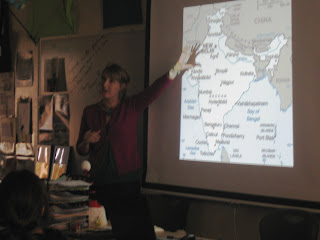
This passed week, with the generous and outstanding help of UCR undergraduate Toby Walker, we made nine CLP presentations to the AVID and LINK Crew classes at

My experience was overwhelmingly positive: teachers were very encouraging and receptive to the project, asking questions and providing ideas on how students may participate.
Our “assignment” (or, as teacher Kristin Podgorski describes it, “our opportunity”) is to create an envelope that will speak to their experience as a youth in
The “opportunity” is as follows (later adapted and improved with help from UCR undergrad, Kevin Eldridge):
---------------------------------------------------------------------------------------
International Peer Leader Assignment #1
“My Life, My
With your individual student profile, you will create an envelope that will be hand-delivered to the student in
This envelope should include the following:
1. Letter of Introduction: “My Life”
- Include your full name, age, grade
- Information about your family
- Your ambition (career) and higher education goals
- Your interests, hobbies, favorites
- Why do you want to go to college? Why is it important to you and your family?
- Ask questions to them based on the profile you are given
What is similar? What is different?
What questions do you have for them?
What are you curious about based on their student profile?
What makes you curious about
Feel free to write more if you would like! Be sure to ask questions you would also feel comfortable answering.
2. “My
Your task is to “show” this student what you think
a. Write one short paragraph about what you love most about your community and your life in
b. Write another paragraph describing what you feel should be changed about your community, your city, your state, your country, or your government. What flaws do you perceive in the
c. Include any photographs, items, notes, pictures, collages, stories. Teach them new words, show family photos, or describe your favorite things! Be creative!
* Please include your Indian student’s name on the outside of your envelope.
** On the back of the envelope, include your contact information at PHS (Full name, teacher’s name and period)
------------------------------------------------------------------------------------
We may have over 90 of these returned to us for our students in

We also had several students approach after class and express interest in participating in a more concrete way. This may result in a possible student organization on campus and a fundraising event with the students there.
In other news, we’ve purchased our domain name (www.childleaderproject.org), have new webmail accounts for our workers (samantha@childleaderproject.org), and a PayPal account where you can donate to us directly!
Thursday, December 11, 2008
A New Era of Updates
Hello CLP-Supporters,
Welcome to a new era of posting by Samantha Wilson.
I notice that I am reluctant to post here-- I only want to post the most professional, most polished, most accomplished statements, when, in reality, life is not like that, let alone attempting to start an NGO.
I pledge to post more regularly, particularly during this "Holiday" season which will consist of reflection, analysis, and new actions for CLP. We have taken many steps forward over the last 10 weeks, and I am eager to reflect on those steps here and post as often as possible.
In the meantime, I'd like to post my "Heck yes! I'm a professional NGO-Woman!" photograph, compliments of UCR Media Services:

"Whoo-hoo! I'm excited to post more frequently!"
Welcome to a new era of posting by Samantha Wilson.
I notice that I am reluctant to post here-- I only want to post the most professional, most polished, most accomplished statements, when, in reality, life is not like that, let alone attempting to start an NGO.
I pledge to post more regularly, particularly during this "Holiday" season which will consist of reflection, analysis, and new actions for CLP. We have taken many steps forward over the last 10 weeks, and I am eager to reflect on those steps here and post as often as possible.
In the meantime, I'd like to post my "Heck yes! I'm a professional NGO-Woman!" photograph, compliments of UCR Media Services:

"Whoo-hoo! I'm excited to post more frequently!"
This evening has been spent organizing the home office. This is the process by which I realize how much this little proposal has grown into a fledgling organization. I smile at a particular folder I had purchased with my friend Hannah last April 2008, where we stood together in Office Depot and debated whether or not to get the "1.5 inch" binder or "3 inch" binder.
"Do I really need all that space?"
"Probably-- if we know anything about you."
I definitely did need that space-- and then some. I have taken over the entire office desk in my family's home (with gratitude to my mother and step-father for their generosity), filling the drawers with papers and articles and curriculum and emails and notes from meetings.
This Winter we have some exciting things to do:
- Finish all the Non-Profit and 501(c)(3) paper work (signatures!)
- Start our newsletter
- Execute the second India-phase of the project (Dec. 26th-Jan. 10th)
- Strengthen our connections to UCR through on-campus involvement in "UCR-CLP"
- Strengthen our connections to communities of faith and social justice
- Seek new partnerships and programs with AVID classes in the Inland Empire
I must express immense gratitude to the help of Theresa Gilbertson and Emily Nudge-- two women who have been my greatest blessing in this ongoing process.
More on the way as I continute to clean. We also look forward to a new website around the corner!
"Do I really need all that space?"
"Probably-- if we know anything about you."
I definitely did need that space-- and then some. I have taken over the entire office desk in my family's home (with gratitude to my mother and step-father for their generosity), filling the drawers with papers and articles and curriculum and emails and notes from meetings.
This Winter we have some exciting things to do:
- Finish all the Non-Profit and 501(c)(3) paper work (signatures!)
- Start our newsletter
- Execute the second India-phase of the project (Dec. 26th-Jan. 10th)
- Strengthen our connections to UCR through on-campus involvement in "UCR-CLP"
- Strengthen our connections to communities of faith and social justice
- Seek new partnerships and programs with AVID classes in the Inland Empire
I must express immense gratitude to the help of Theresa Gilbertson and Emily Nudge-- two women who have been my greatest blessing in this ongoing process.
More on the way as I continute to clean. We also look forward to a new website around the corner!
Subscribe to:
Posts (Atom)
